TanStack Hono: A Lightweight SSR Monolith Without the Meta-Framework Weight
Preface
I’ve been using TanStack Router and Hono for a while and appreciate their shared philosophy: TanStack Router offers a strongly typed, data-aware routing core, while Hono provides a tiny, fast, standards-based HTTP layer.
This project explores combining them into a single TypeScript SSR + CSR monolith. It runs as one process in development, handling server-rendered React routes, client hydration, and lightweight RPC endpoints without the weight of a full meta-framework.
I adapted the official TanStack Router SSR example, swapping Express for Hono and adding a typed RPC API.
Repo: github.com/bskimball/tanstack-hono
Development relies on the Hono dev server with Vite, ensuring hot reloading works across routes, server handlers, and shared types.
Why Hono?
Hono is a minimalist, high-performance web framework. Its small footprint makes it ideal for serverless and edge environments. Its middleware system makes composing request handlers, RPCs, Zod validations, and OpenAPI-compatible REST APIs straightforward.
Why TanStack Router?
TanStack Router is a powerful routing library with first-class type safety and data awareness. It supports nested routes, route loaders, and seamless React integration. Its type safety catches errors at compile time, and its flexibility allows it to run in various environments.
Why a “Monolith”?
Here, “Monolith” means a single repository and runtime process handling:
- HTTP routing (API + SSR HTML).
- React server rendering + hydration.
- Static asset compilation (Vite).
- Type-safe internal RPC endpoints.
The goal: low operational complexity with progressive enhancement and dynamic UI.
Architecture Overview
- Request enters Hono.
- API/RPC Check: Matches against routes like
/api/todos. If matched, returns JSON. - SSR Fallback:
- Creates a TanStack Router instance.
- Resolves route elements (no framework-specific loaders).
- Renders React to string/stream.
- Injects serialized router state and asset tags.
- Hydration: Client hydrates the router; subsequent navigation is client-side.
File Layout
src/
  components/      # Shared React components
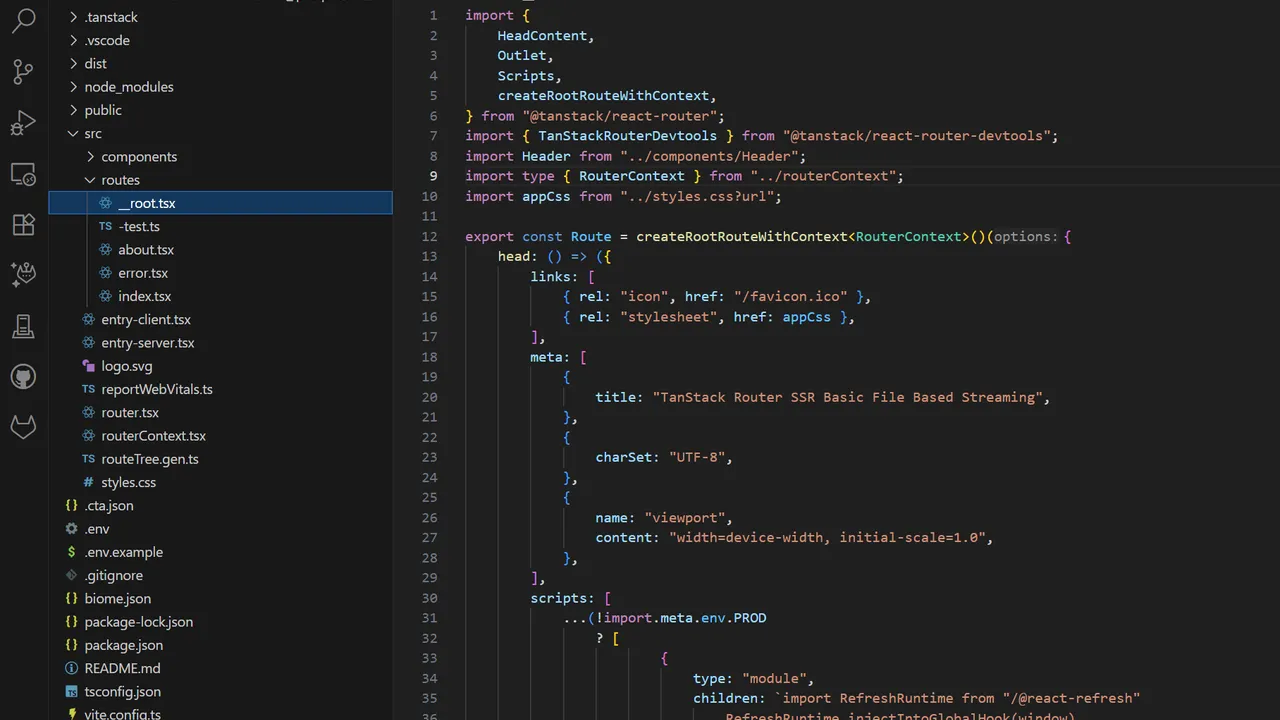
  routes/          # TanStack Router file-routes
    __root.tsx
    index.tsx
    about.tsx
    todos/
  api/             # Hono handlers / RPC
    todos.ts
  shared/          # Shared Types / Zod schemas
    types.ts
  entry-client.tsx # Hydration entry
  entry-server.tsx # Server render entry
If you want a leaner alternative to Next.js but still need SSR, type-safe RPC, and file-based routing, this stack is worth exploring. The repo is a complete working example you can clone and extend.
A Modern Feathers.js Stack on IBM i: Real-Time APIs on DB2
Real-time WebSockets, REST APIs, and a Vite React frontend running directly on IBM i using Feathers.js and a custom Knex adapter for DB2.
A Feathers.js Prototype for Customer Demographics and Automated Emails
A proof-of-concept full-stack app using Feathers.js, React, Vite, and shadcn/ui to manage customer demographics and trigger anniversary and birthday emails.
Building Compass: A Life Assistant That Still Works When the AI Does Not
I wanted a more customizable workout tracker, a budget my wife and I could share, and AI help on both. So I built Compass on TanStack Start and Cloudflare, and made sure it still works when the AI does not.